To calculate shared utility costs for rental properties clearly, first separate any owner or common-area portion from the source bill. Then apply the documented tenant split only to the remaining amount. This simple order prevents tenants from being charged for costs that do not belong in their allocation and makes every request easier to explain.
For example, if a $300 electricity bill includes a 10% owner share for common-area lighting, the tenant-paid amount is $270. If three tenants share that remainder equally, each tenant’s share is $90. Dividing the full $300 first would produce $100 each and leave the owner portion unaccounted for.
At zSplit, we help landlords and rental property owners calculate tenant shares, send email payment requests, and keep payment information connected to each shared expense. The calculation is only one part of the process. A useful record also shows what the bill covered, which period it applies to, how the share was determined, and what happened after the request was sent.
Start with the written rental arrangement
Before assigning a tenant any part of a utility bill, review the lease or rental agreement and the requirements that apply where the property is located. The agreement should establish whether utilities are included in rent or billed separately, which costs tenants are responsible for, and how shared costs are allocated.
This is especially relevant when one utility meter serves multiple units or spaces. A formula can be correct while the charge itself is unclear or inconsistent with the arrangement. Do not change an established split simply because another calculation produces a more convenient outcome for one billing cycle.
For each recurring utility, document the basics before the next bill arrives:
- What the charge covers, such as water, electricity, gas, or internet.
- Which tenants or units participate in the split.
- Whether a common area or owner-used space has a separate share.
- The allocation method for the tenant-paid remainder.
- When requests are normally sent and when payment is due.
Identify costs that should not be divided among tenants
A shared utility bill can serve more than tenant spaces. Hallway or exterior lighting, shared laundry, garages, owner-used areas, and other common spaces can create a portion that should be kept separate from tenant charges. The right treatment depends on the written arrangement and the property setup.
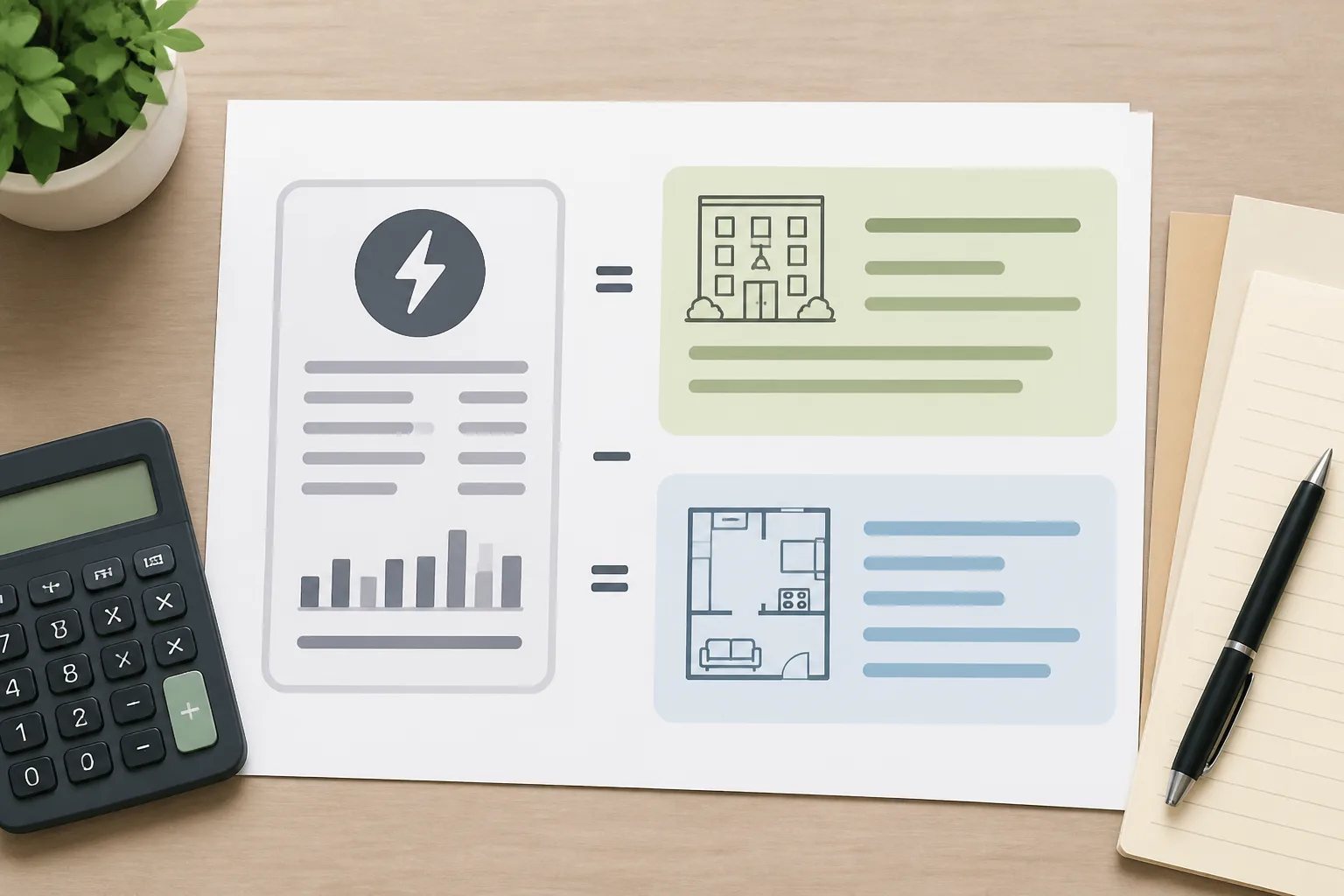
Separate this portion before applying an equal or percentage split. That keeps two different decisions from becoming one confusing calculation: first, determine the amount tenants are responsible for; second, determine how that tenant-paid amount is shared.
Use a clear calculation trail:
- Start with the full source bill.
- Calculate and record the owner or common-area portion.
- Subtract that amount from the full bill.
- Apply the agreed tenant allocation to the remainder.
- Record each tenant’s exact amount due.
Suppose a $420 water bill includes a documented 15% owner share. The owner portion is $63, leaving $357 to allocate. If the two participating units have fixed shares of 60% and 40%, their tenant-paid shares are $214.20 and $142.80. Showing the intermediate $357 total makes the result much easier to check.
Calculation principle
Split the tenant-paid remainder, not automatically the full bill
If a utility serves common areas or owner-used space, identify and document that share first. The remaining balance is the amount available for the agreed tenant allocation, making the full bill and collected total reconcile clearly.
Choose a split method that fits the remaining tenant-paid amount
There is no universal formula for shared utilities. The suitable method is the one established in the rental arrangement and applied consistently. Once any owner or common-area share has been removed, common approaches include equal shares, fixed percentages, and measured usage.

| Method | How it works | Key point to document |
|---|---|---|
| Equal split | Divides the tenant-paid amount evenly among agreed tenants or units. | Whether the split is by person or by unit. |
| Fixed percentage | Applies a saved percentage to each bill after the owner share is removed. | Each assigned percentage and the basis for it. |
| Measured usage | Uses reliable, agreed unit-level consumption data where available. | The reading source and treatment of fixed charges or common-area use. |
Square footage can also be used to establish fixed unit percentages where that matches the agreement. For example, a unit with 1,200 square feet out of 2,000 square feet of rental space represents 60%. That percentage can be applied to eligible shared bills, but square footage is not a direct measurement of utility consumption.
Our Unit Split Percentage Calculator can help check equal or square-footage-based unit percentages. For a specific bill, our Utility Bill Split Calculator calculates equal and percentage-based shares.
Keep fixed rent and variable utilities as separate charges
Rent is often a fixed recurring charge, while utilities can change in amount and may cover a service period different from the month in which the bill arrives. Keeping them as distinct line items lets a tenant see what is rent, what is a utility share, and which item needs clarification.
A combined balance can hide useful information. If a tenant has a question about an April water bill, that question should not make it difficult to confirm the status of May rent. Separate records also make corrections cleaner: an updated utility calculation can replace a utility request without changing the rent record.
Make every shared-utility request verifiable
An amount alone is not a complete payment request. A tenant should be able to understand the charge without searching through an old email thread or guessing which billing period it belongs to.
For a variable utility, include the expense name, service period, full bill amount where helpful, any owner or common-area portion, the allocation method, the tenant’s exact share, payment instructions, and a specific due date. When a source bill is available, sharing it can also help a tenant verify a variable charge.
A concise request might read: “Your April electricity share is $90. The full bill was $300, with $30 assigned to common-area use. The remaining $270 is divided equally among three tenants. Payment is due May 10.” It answers the essential questions: what the expense is, what period it covers, why the amount differs from the full bill, and when payment is expected.
We let you calculate tenant shares and send itemized email payment requests in one workflow. Pro and Pro Plus users can attach PDF files or images to bill payment requests.
Use the same review sequence for each bill
Most avoidable problems start with incorrect inputs rather than incorrect arithmetic: the wrong service period, an outdated percentage, a missing owner share, or an incorrect email address. A short review before sending a request is more efficient than correcting several messages later.
Pre-send checklist
Review these details before sending a utility request
Use the same quick check for every variable shared expense.
- Confirm the source bill amount and the correct service period.
- Check participating tenants or units and any owner or common-area portion.
- Verify the documented split method and resulting individual shares.
- Review the expense name, due date, payment instructions, and recipient email addresses.
- Send individual itemized requests after the details match the source record.
We do not connect to utility providers or automatically pull bill amounts. Landlords enter the bill amounts they receive, so comparing the entered amount and billing period with the source document remains an essential check.
Track status after the request is sent
A sent request is not the end of the record. Track what happened next so that payment follow-up is based on facts rather than memory. A practical set of statuses is pending, paid, overdue, and cancelled.
- Pending: The request was sent, but payment has not been confirmed.
- Paid: Payment was received and confirmed. Update the record promptly to prevent unnecessary reminders.
- Overdue: The due date has passed without confirmed payment. Check the details before following up.
- Cancelled: The request should no longer be collected, often because it was corrected or replaced.
If a request contains an error, retain the original history, cancel it where appropriate, and send an updated request with a clear final amount. Quietly changing the original figure makes later reconciliation harder.
All zSplit accounts can view sent payment request history and request details. Pro and Pro Plus plans add payment-status tracking, reports, and exports. Those plans also support resending requests, while Pro Plus includes overdue reminders. Our guide to using zSplit explains the setup and monthly workflow.
Keep reminders factual and individual
Before sending a reminder, verify the expense, billing period, amount due, original due date, and current status. A missed email, payment made under another reference, and a question about the calculation are different situations, but each should begin with the same record review.
Keep routine messages brief and non-personal. State what remains pending in your records, then offer a useful next step such as confirming payment, resending the request, or clarifying the calculation. Send requests and reminders individually rather than disclosing one tenant’s payment status in a group message.
Routine email follow-up is administrative communication. Formal late-payment notices, fees, and tenancy consequences can be regulated, so review the agreement and applicable requirements before using enforcement language.
When the source bill, owner share, allocation rule, request, and payment status remain connected, a shared utility charge becomes straightforward to explain. The goal is not to make every property use the same split. It is to make each property’s agreed arrangement visible, repeatable, and easy to review.
Helpful answers
Frequently Asked Questions
Keep shared utility records connected
Set up tenant shares, send itemized requests, and keep each payment request tied to its status.