
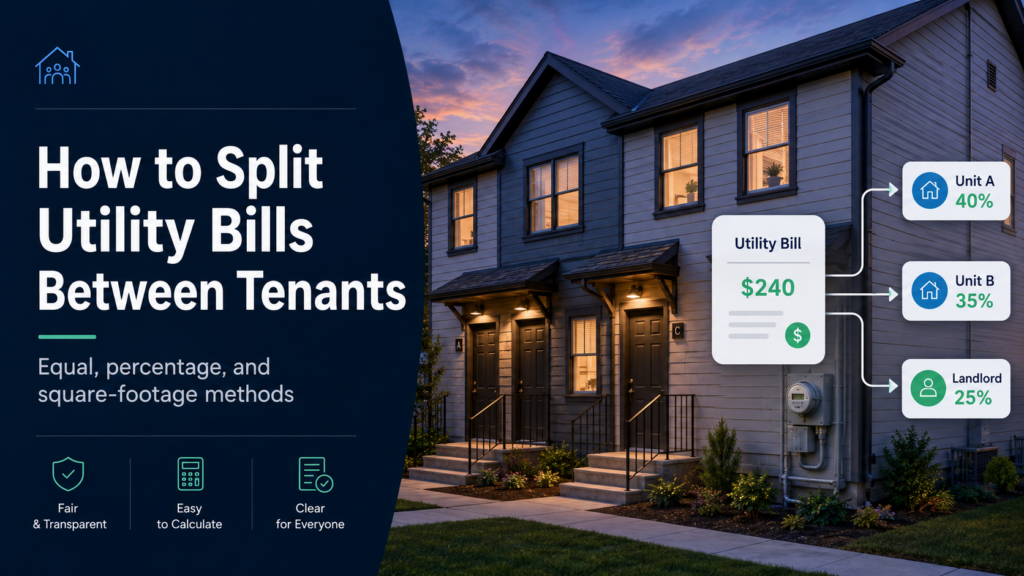
How to Split Utility Bills Between Tenants
If one utility bill covers multiple tenants or rental units, landlords and property managers usually split the bill using one of five methods: equal split, percentage split, square footage split, fixed tenant share, or landlord share.
The best way to split utility bills between tenants depends on the lease, the property setup, the number of tenants or units, and your local landlord-tenant rules.
For example, if a $300 electricity bill is split equally between 3 tenants, each tenant owes $100. If that same $300 bill is split 60/40 between two units, one unit owes $180 and the other owes $120.
This guide explains the most common ways landlords split utility bills, with simple examples you can copy. If you already have a bill amount and just want to calculate each tenant’s share, you can use zSplit’s free Utility Bill Split Calculator.
Before Splitting a Utility Bill, Check the Lease and Local Rules
Before charging tenants for utilities, landlords and property managers should check what the lease says and what local rules allow.
This is especially important when one meter is shared by multiple tenants or rental units. In some areas, utility charges need to be clearly agreed to in the lease. Some places may also have rules about how shared utility costs can be divided.
Before splitting a utility bill, check:
- Whether utilities are included in rent or charged separately
- Whether the lease explains how utilities are divided
- Whether the split is by tenant, unit, square footage, percentage, or another method
- Whether the utility is individually metered or shared
- Whether the landlord is responsible for any portion of the bill
- Whether your local landlord-tenant rules allow the method you are using
This article explains the math and common utility-splitting methods. Always check your lease and local rules before charging tenants for shared utilities.
Common Ways to Split Utility Bills Between Tenants
There is no single method that works for every rental property. The most common ways to split utility bills between tenants are:
| Split Method | Best For | Simple Example |
|---|---|---|
| Equal split | Similar tenants or units | $300 bill ÷ 3 tenants = $100 each |
| Percentage split | Assigned tenant or unit shares | 60% / 40% split on a $300 bill |
| Square footage split | Units of different sizes | Larger unit pays a larger share |
| Fixed tenant share | Lease assigns a set amount or share | Tenant pays $75/month or 30% |
| Landlord share | Common areas or landlord-used space | Landlord covers 10%, tenants split 90% |
Each method can be fair when it is clear, consistent, and agreed to properly.
1. Equal Split Method
An equal split is the simplest way to divide a utility bill among tenants or units.
With an equal split, every tenant or rental unit pays the same amount.
Equal Split Formula
Total utility bill ÷ number of tenants or units = amount each tenant or unit owes
Equal Split Example
A landlord receives a $240 electricity bill for a property with 3 tenants.
$240 ÷ 3 = $80
Each tenant owes $80.
This method is simple and easy to explain. It may work well when the tenants share the property equally, the units are similar, or the lease says utilities are divided equally.
However, an equal split may not always feel fair if one unit is much larger, one unit has more occupants, or one tenant uses more of the property than another.
For a quick equal split, use the Utility Bill Split Calculator and enter the total bill amount and number of tenants or units.
2. Percentage Split Method
A percentage split means each tenant or unit is responsible for a specific percentage of the utility bill.
This is common when one unit is larger than another, one tenant has a larger share of the property, or the lease assigns a specific utility split.
Percentage Split Formula
Total utility bill × tenant percentage = tenant utility share
Percentage Split Example
A duplex has one main-floor unit and one basement unit.
The lease says:
Main floor unit: 65%
Basement unit: 35%
The monthly gas bill is $200.
Main floor: $200 × 65% = $130
Basement: $200 × 35% = $70
The main-floor tenant owes $130.
The basement tenant owes $70.
A percentage split can be a good option when you want a more flexible way to divide utilities between tenants or units.
If the tenants are covering the full utility bill, the percentages should usually add up to 100%.
For example:
Unit A: 50%
Unit B: 30%
Unit C: 20%
Total: 100%
If the landlord is covering part of the bill, the tenant percentages may only apply to the tenant-paid portion.
3. Square Footage Split Method
A square footage split uses the size of each rental unit to calculate its share of the bill.
This can be useful when one unit is much larger than another. For example, a main-floor unit may be larger than a basement apartment, or one unit may have more bedrooms and living space.
Square Footage Split Formula
Unit square footage ÷ total rental square footage = unit percentage
Then:
Total utility bill × unit percentage = amount owed
Square Footage Split Example
A rental property has two units:
Main floor unit: 1,200 sq. ft.
Basement unit: 800 sq. ft.
Total rental space: 2,000 sq. ft.
Main floor percentage:
1,200 ÷ 2,000 = 60%
Basement percentage:
800 ÷ 2,000 = 40%
Now let’s say the monthly water bill is $250.
Main floor: $250 × 60% = $150
Basement: $250 × 40% = $100
The main-floor unit owes $150.
The basement unit owes $100.
This method can feel fairer when units are different sizes, especially for utilities connected to the property as a whole.
If you need to calculate percentages first, use the Unit Split Percentage Calculator. Once you know each unit’s percentage, you can use the Utility Bill Split Calculator to split the actual monthly bill.
4. Fixed Tenant Share Method
A fixed tenant share means the tenant pays a set amount or a set percentage toward utilities.
There are two common versions:
- A fixed dollar amount
- A fixed percentage of the actual bill
Fixed Dollar Amount Example
The lease says the tenant pays $100 per month toward utilities.
In this case, the tenant pays $100 each month, even if the actual bill changes.
This is simple, but it may not always match the true monthly utility cost.
Fixed Percentage Example
The lease says Tenant A pays 30% of shared utilities.
The monthly utility bill is $400.
$400 × 30% = $120
Tenant A owes $120.
A fixed percentage is more flexible than a fixed dollar amount because it changes with the actual monthly bill.
This method is useful when the tenant’s share is clearly written in the lease and stays consistent from month to month.
5. Landlord Share Method
Sometimes the landlord or property manager may cover part of the utility bill before splitting the rest between tenants.
This may apply when:
- There are shared common areas
- The landlord uses part of the property
- Exterior lighting is connected to the same meter
- A hallway, laundry area, garage, or storage area is shared
- The lease says the landlord covers part of the utility cost
- The full bill should not be passed on to tenants
Landlord Share Example
The total electricity bill is $300.
The landlord covers 10% for common areas.
Landlord share:
$300 × 10% = $30
Tenant-paid portion:
$300 – $30 = $270
Now the remaining $270 is split between tenants.
If there are 3 tenants splitting the tenant-paid portion equally:
$270 ÷ 3 = $90
Each tenant owes $90.
The landlord covers $30.
This method can be useful when the entire bill is not strictly tenant usage.
How to Split Electricity or Hydro Bills Between Tenants
To split an electricity or hydro bill between tenants, use the method written in the lease or rental agreement.
In many Canadian markets, “hydro” is commonly used to refer to electricity. In the United States, landlords and property managers will usually refer to this as the electricity bill or electric bill.
The most common ways to split an electricity or hydro bill are:
- Equal split
- Percentage split
- Square footage split
- Fixed tenant share
- Landlord share first, then tenant split
Electricity or Hydro Split Example
The hydro bill is $180.
There are 2 tenants splitting it equally.
$180 ÷ 2 = $90
Each tenant owes $90.
Now let’s say the same $180 bill is split 70/30.
Tenant A: $180 × 70% = $126
Tenant B: $180 × 30% = $54
Tenant A owes $126.
Tenant B owes $54.
How to Split Water Bills Between Tenants
Water bills can be split in several ways, depending on the property and lease.
A landlord or property manager may split a water bill equally, by percentage, by square footage, or by another agreed method.
Water usage can vary depending on the number of occupants, laundry use, bathrooms, outdoor water use, and other property-specific factors.
Water Bill Split Example
The monthly water bill is $150.
The property has two units:
Main unit: 60%
Basement unit: 40%
Main unit:
$150 × 60% = $90
Basement unit:
$150 × 40% = $60
The main unit owes $90.
The basement unit owes $60.
How to Split Gas Bills Between Tenants
Gas bills are often connected to heating, so unit size can matter.
For example, a larger unit may require more heating than a smaller unit. In that case, a square footage split or percentage split may make more sense than an equal split.
However, the correct method still depends on the lease, property setup, and local rules.
Gas Bill Split Example
The monthly gas bill is $220.
The lease says:
Unit A: 65%
Unit B: 35%
Unit A:
$220 × 65% = $143
Unit B:
$220 × 35% = $77
Unit A owes $143.
Unit B owes $77.
What Is the Fairest Way to Split Utilities Between Tenants?
The fairest way to split utilities between tenants depends on the property.
An equal split may be fair when the units are similar or tenants share the property evenly.
A percentage split may be fair when one tenant or unit should pay a larger share.
A square footage split may be fair when rental units are different sizes.
A landlord share may be fair when part of the utility bill covers common areas or landlord-used space.
In general, the best way to split utilities between tenants is the method that is:
- Clearly explained
- Written into the lease or rental agreement
- Allowed by local rules
- Easy for tenants to understand
- Easy for the landlord or property manager to calculate
- Consistent from month to month
Fairness is not only about the math. It is also about clarity.
Tenants are less likely to be confused or frustrated when they understand exactly how their share was calculated.
Utility Bill Split Examples
Here are a few simple examples showing how to calculate tenant utility share.
Example 1: Equal Split Between 4 Tenants
Total utility bill: $360
Number of tenants: 4
$360 ÷ 4 = $90
Each tenant owes $90.
Example 2: Percentage Split Between 2 Units
Total utility bill: $280
Unit A: 60%
Unit B: 40%
Unit A:
$280 × 60% = $168
Unit B:
$280 × 40% = $112
Unit A owes $168.
Unit B owes $112.
Example 3: Square Footage Split Between 2 Units
Unit A: 1,000 sq. ft.
Unit B: 500 sq. ft.
Total: 1,500 sq. ft.
Unit A percentage:
1,000 ÷ 1,500 = 66.67%
Unit B percentage:
500 ÷ 1,500 = 33.33%
Total utility bill: $210
Unit A:
$210 × 66.67% = $140
Unit B:
$210 × 33.33% = $70
Unit A owes $140.
Unit B owes $70.
Common Mistakes Landlords and Property Managers Should Avoid
Splitting utility bills is simple when the method is clear, but mistakes can create confusion.
Here are some common mistakes to avoid:
Splitting Bills Without Checking the Lease
Before charging tenants, check whether the lease allows utility charges and explains how they are calculated.
Changing the Split Method Without Agreement
If tenants agreed to one method, do not switch to another method without checking the lease and local requirements.
For example, changing from equal split to square footage split may affect what each tenant owes.
Forgetting to Show the Bill Amount
Tenants may want to understand what they are paying for.
When possible, show the total utility bill amount and how their share was calculated.
Using Percentages That Do Not Add Up Properly
If tenants are covering the full bill, the percentages should usually add up to 100%.
For example:
Unit A: 50%
Unit B: 30%
Unit C: 20%
Total: 100%
If the landlord is covering part of the bill, make that clear before splitting the tenant-paid portion.
Not Documenting Tenant Payments
When utility payments are handled manually, it can be easy to lose track of who paid and who still owes.
This becomes more difficult when you manage multiple tenants, units, properties, or monthly bills.
Recalculating Everything Manually Every Month
A calculator can help with one bill. But if you are splitting utilities every month, manually calculating tenant shares, writing messages, sending payment requests, and tracking payments can become repetitive.
That is where a system like zSplit can help.
Calculate a Shared Utility Bill
If you need to split one bill right now, use zSplit’s free Utility Bill Split Calculator.
You can use it for:
- Electricity bills
- Hydro bills
- Gas bills
- Water bills
- Internet bills
- Shared property expenses
- Other recurring tenant charges
Enter the total bill amount, choose the split method, and calculate what each tenant or unit owes.
If you need to calculate each unit’s percentage first, use the Unit Split Percentage Calculator. This is helpful when you want to split utilities equally between units or by square footage.
Make Monthly Utility Splitting Easier with zSplit
A calculator is useful when you need to split one utility bill.
But if you are a landlord or property manager who splits shared bills every month, you may want a more organized way to manage the full process.
zSplit helps landlords and property managers handle shared tenant bills more easily.
With zSplit, you can:
- Add your property
- Add units
- Add bills
- Add tenants
- Set split percentages
- Send payment requests
- Keep utility splitting organized month after month
Instead of manually recalculating each tenant’s share every time a gas, water, hydro, or electricity bill arrives, zSplit helps you turn the monthly utility split into a repeatable process.
Use the free calculator when you need a quick answer.
Use zSplit when you want to make monthly tenant utility splitting easier.
Frequently Asked Questions
How do you split utility bills between tenants?
You can split utility bills between tenants equally, by percentage, by square footage, by fixed tenant share, or by having the landlord cover part of the bill first. The right method depends on the lease, the property setup, and local rules.
What is the easiest way to split utilities between tenants?
The easiest way to split utilities between tenants is an equal split. Divide the total utility bill by the number of tenants or units.
For example, a $300 bill split between 3 tenants is $100 each.
What is the fairest way to split utilities between tenants?
The fairest way depends on the property. Equal splits may work well when units are similar. Percentage splits or square footage splits may be better when units are different sizes. The fairest method is usually the one that is clear, consistent, written into the lease, and allowed by local rules.
How do I calculate tenant utility share?
To calculate tenant utility share, multiply the total bill by the tenant’s percentage.
For example:
$200 utility bill × 40% tenant share = $80
For an equal split, divide the bill by the number of tenants or units.
How do I split a utility bill with tenants?
Start by checking the lease and local rules. Then choose the correct split method, such as equal split, percentage split, square footage split, fixed share, or landlord share. Once the method is clear, calculate each tenant’s amount and provide the total bill and calculation.
How do I split a hydro bill between tenants?
To split a hydro bill between tenants, use the method in the lease. For an equal split, divide the hydro bill by the number of tenants or units. For a percentage split, multiply the hydro bill by each tenant’s assigned percentage.
How do I split an electricity bill between tenants?
An electricity bill can be split equally, by percentage, by square footage, or by another agreed method. For example, if a $180 electricity bill is split equally between 2 tenants, each tenant owes $90.
How do I split a water bill between tenants?
A water bill can be split equally, by percentage, by square footage, or by another method agreed to in the lease. For example, if a $150 water bill is split 60/40, one unit owes $90 and the other owes $60.
Can landlords split utility bills between tenants?
Landlords may be able to split utility bills between tenants when the lease allows it and local rules permit it. Because rental rules vary by location, landlords and property managers should check their lease and local landlord-tenant rules before charging tenants for utilities.
Do utility split percentages need to equal 100%?
If tenants are covering the full utility bill, the split percentages should usually add up to 100%.
For example:
Tenant A: 50%
Tenant B: 30%
Tenant C: 20%
Total: 100%
If the landlord is covering part of the bill, the tenant percentages may only apply to the tenant-paid portion.
Ready to simplify expense splitting?
Join other landlords who save time with zSplit.